Work · Fig. 01
DealFlow CRM
A CRM for real-estate agents, built because a working agent couldn't find one that did the job. DealFlow is its own business with its own customers. It's here because it's the clearest proof of what we build.
- Type
- Web app that installs to the desktop
- Built with
- Supabase (database, auth, server functions), Stripe billing
- Data
- A licensed MLS feed: 42,190 listings, synced twice a day
- Status
- Live, with real users (not yet paying) · dealflowcrm.app
 1
2
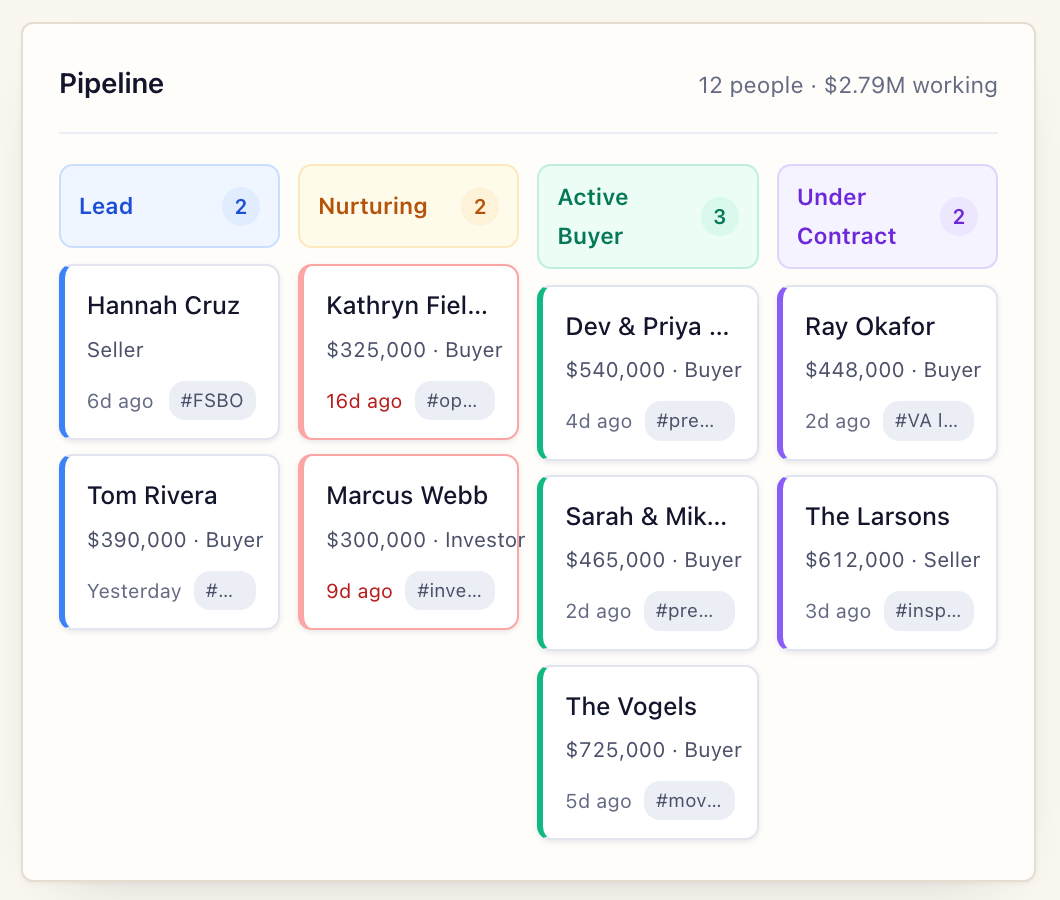
- The board totals live dollar volume, so the number that matters is the first thing on screen.
- A follow-up that's slipped turns red on the card. Nobody has to remember to check.
01The problem
Agents were paying for a CRM that tracked names but knew nothing about a deal, a spreadsheet to underwrite anything worth buying, and a third tool to send follow-up. Three tools, three logins, and the one question that mattered (who do I call this morning?) wasn't answered by any of them.
02The hard part
Licensed data comes with rules. An MLS feed isn't just an API: the license says how long listing data can be kept, and it requires erasure on request. That second rule is the one that bites, because it rules out ordinary point-in-time backups: you can't restore a snapshot that brings back something you were required to delete.
So the build started with the license rather than the code: a compliance register, an attorney memo, and a sync that respects retention by design, not by someone remembering to clean up.
03What we built
- Pipeline, contacts and sphere, drip and holiday campaigns
- Deal underwriting and pricing tools
- Buyer-to-listing matching against the live feed, synced twice a day
- Thirteen server functions, subscription billing, and an app that installs to the desktop
04What it shows about us
If your business runs on data someone else licenses to you, like a supplier catalog, a scheduling platform or a regulated feed, the license is part of the spec. We read it first, and we build so the rules hold without anyone having to remember them.